
Investigating the potential for redox-active organic matter reduction in high elevation wetlands of the Colorado Rocky Mountains, USA
Schroeder, A. K., Rush, J. E., Dragone, N. B., Rea, L. T., & Hinckley, E.-L. S. 2026. Investigating the potential for redox-active organic matter reduction in high elevation wetlands of the Colorado Rocky Mountains, USA. Arctic, Antarctic, and Alpine Research, 58(1), 2652652.Available at https://doi.org/10.1080/15230430.2026.2652652.
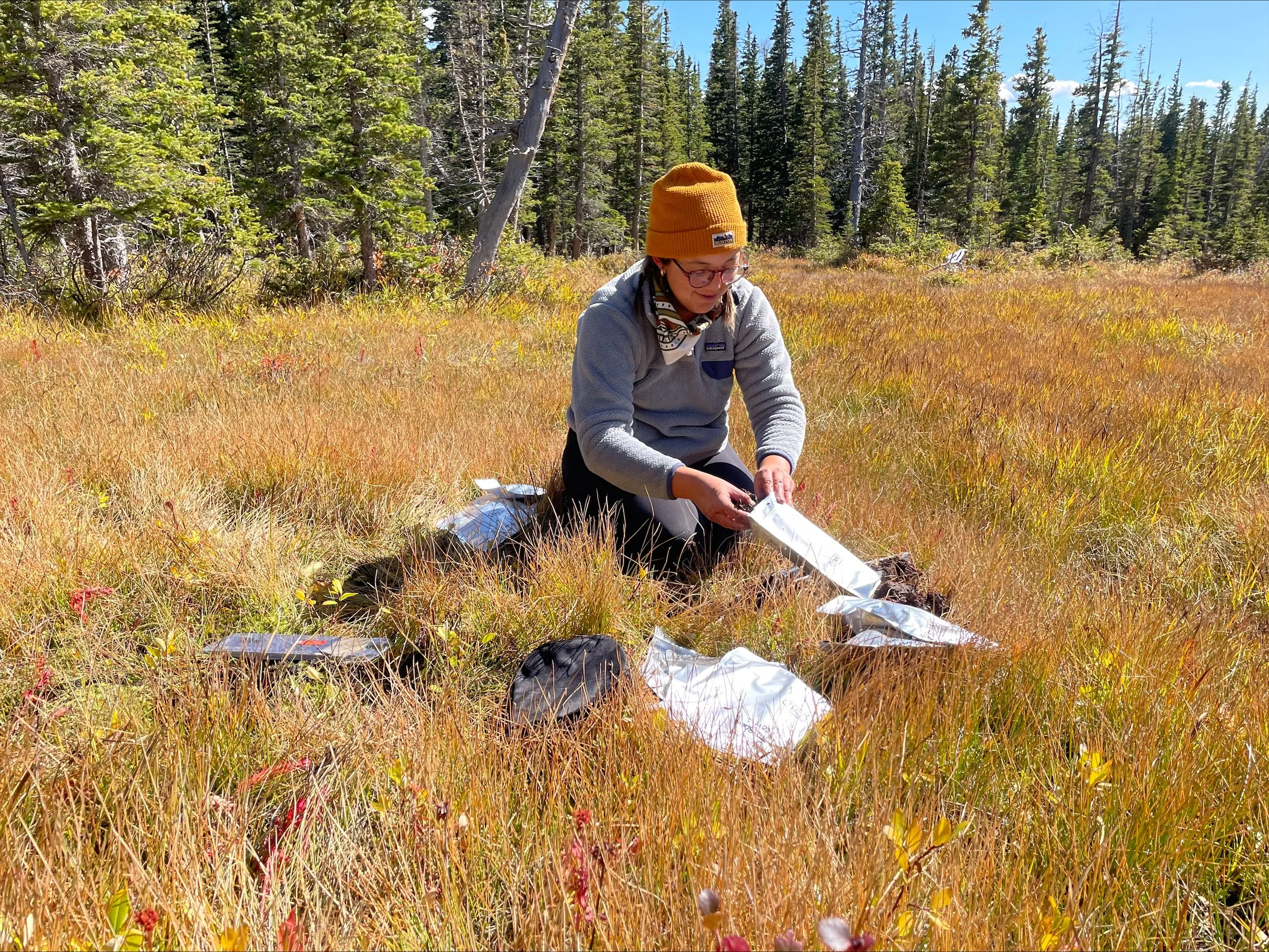
Annaliese Schroeder collecting samples at Niwot Ridge. Photo credit: Jessica Rush
Abstract
High elevation wetlands can support accelerated rates of biogeochemical cycling by storing and releasing large amounts of carbon (C). However, little is known about the controls on C cycling in these remote ecosystems. We investigated redox-active organic matter (RAOM) reduction, methane and carbon dioxide production, and microbial community composition located within three different wetlands of the Niwot Ridge Long-Term Ecological Research site: a subalpine wetland (SAW), periglacial solifluction lobe (PSL), and alpine wet meadow (AWM). After a sixty-three-day anaerobic laboratory incubation, soils from the SAW and PSL had similar amounts of reduced RAOM ( 60 μmol e– g–1 dry weight [dw] soil, p = .7). Methane production was significantly higher in the SAW ( 350 μmol C g−1 dw soil) than in the PSL ( 25 μmol C g−1 dw soil; p < .005) and was negligible until RAOM was reduced by day 21. Microbial community analysis showed that though both SAW and PSL had microbes capable of reducing RAOM present, the PSL had significantly higher diversity compared to the SAW (p = .01). Collectively, these results demonstrate that RAOM reduction is an important process in the high elevation wetland C cycling with the potential to control methane production in high elevation wetlands, particularly subalpine wetlands.