
Spring comes early, but do the fungi? Plant phenology mediates plant–fungal interactions under experimental early snowmelt in alpine tundra
Meeder, A., Bueno De Mesquita, C. P., Henn, J. J., Forrester, C., Callaway, M., Schmidt, S., & Suding, K. (2026). Spring comes early, but do the fungi? Plant phenology mediates plant–fungal interactions under experimental early snowmelt in alpine tundra. Arctic, Antarctic, and Alpine Research, 58(1), 2659410. https://doi.org/10.1080/15230430.2026.2659410
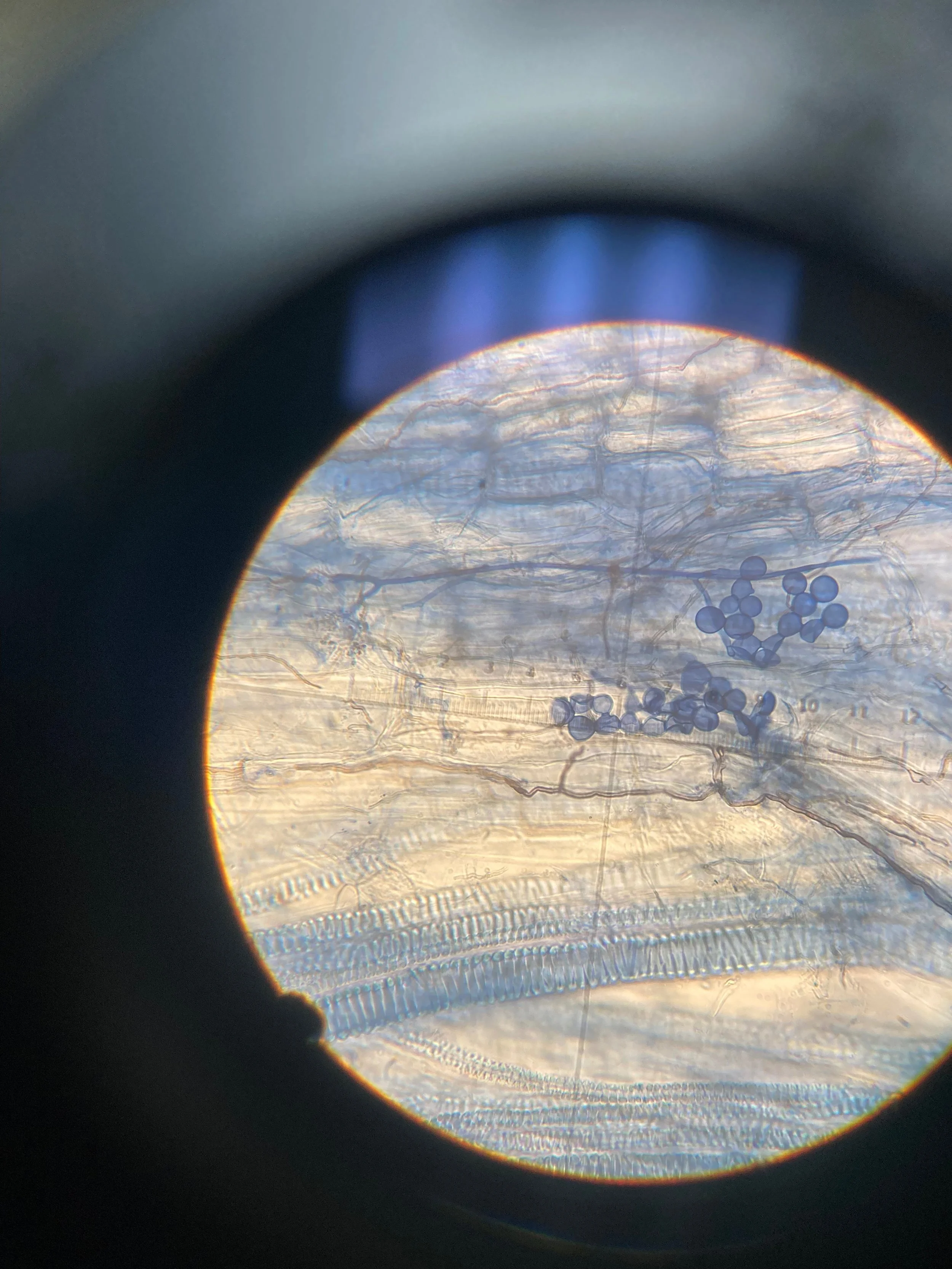
Dark septate endophytes. and arbuscular mycorrhizal fungi Photo credit: Annie Meeder
Abstract
Alpine plants experience strong seasonal shifts in resource demand and availability, yet how these dynamics shape fungal colonization remains unclear. We measured root colonization by arbuscular mycorrhizal fungi, fine root endophytes, and dark septate endophytes across six alpine plant species at Niwot Ridge, Colorado, in an early snowmelt simulation experiment and asked how colonization related to changes in plant phenology and seasonal nutrient context. Using a causal inference, we demonstrate that fungal colonization was indirectly influenced by early snowmelt through shifts in plant phenology: plots with later snowmelt timing had later flowering onset and seed set, which in turn supported greater fungal colonization. Because nutrient measurements were collected in a separate subplot-based data set, we use them to describe seasonal nutrient context rather than as intermediates in our causal models. Together, our results identify phenology as the mediator linking snowmelt timing to fungal colonization. We conclude that climate-driven shifts in snowmelt and reproduction timing can alter when plants recruit fungal partners: earlier reproduction is associated with reduced colonization if it occurs during higher nutrient pulses, whereas later reproduction is associated with greater colonization in drier late-season conditions.