
Natural snow accumulation gradients mediate environmental and plant trait responses to earlier snowmelt in alpine tundra
Henn, J. J., Bardsley, K., Bueno de Mesquita, C. P., Elmendorf, S. C., Emery, N. C., Farrer, E. C., Forrester, C., Smith, J. G., Spasojevic, M. J., Morse, J. F., & Suding, K. N. (2026). Natural snow accumulation gradients mediate environmental and plant trait responses to earlier snowmelt in alpine tundra. Global Change Biology, 32(8), e71068. https://doi.org/10.1111/gcb.71068.
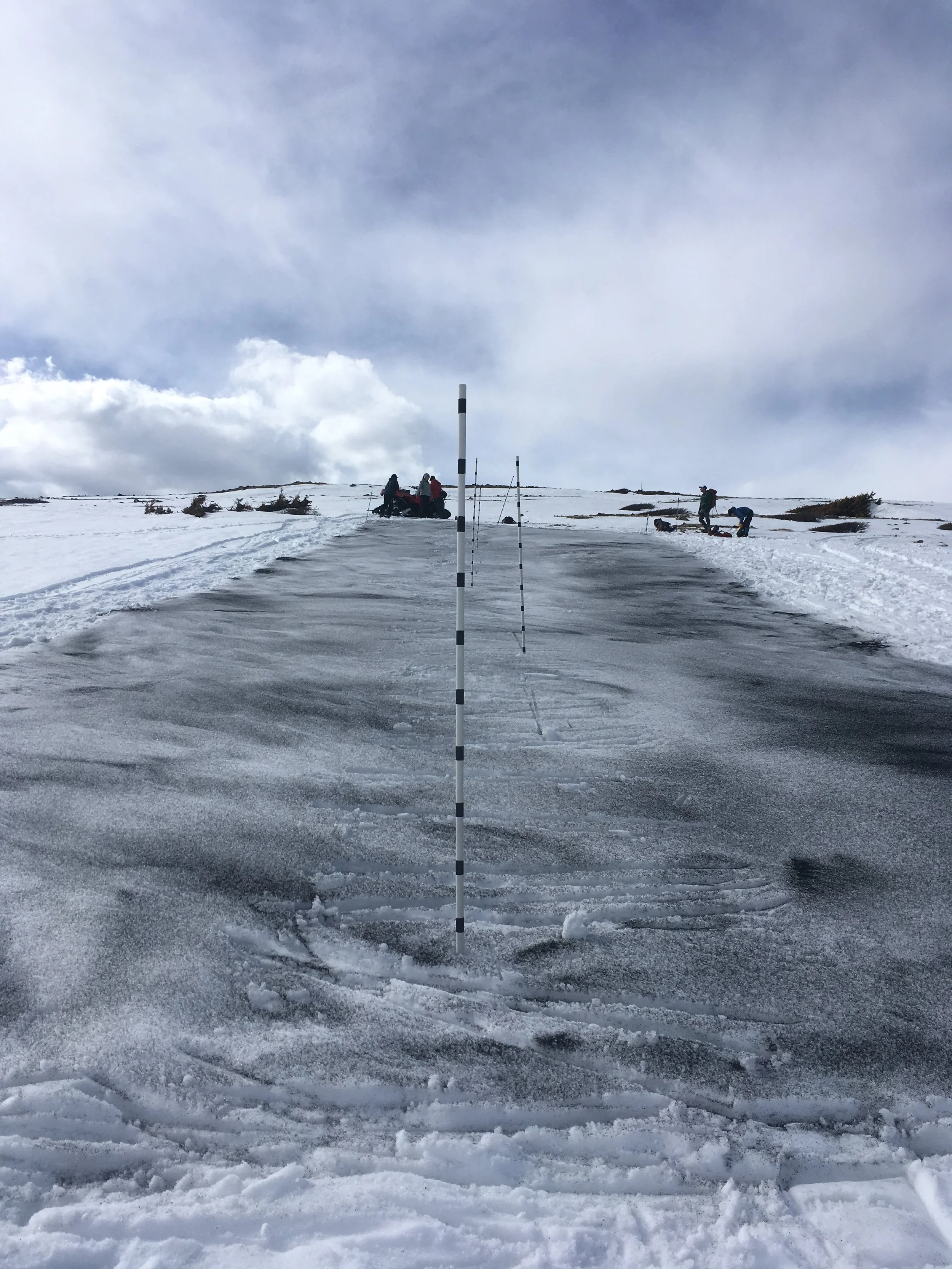
Inert black sand was used to increase albedo and stimulate early snowmelt. Figure credit: Cliff Bueno de Mesquita
Abstract
Mountain ecosystems are experiencing rapid climate changes, with implications for biodiversity and ecosystem function. Changing snow dynamics, especially earlier melt, are influencing the timing and length of growing seasons, species phenology, and plant abundance. Because mountains are characterized by high topographical and microclimatic variation, effects of changing snow dynamics may depend on small-scale variation in topographically mediated snow accumulation. Wind-scoured areas frequently lack snow cover and thus may be less vulnerable to earlier snowmelt than areas of deep snow accumulation. Here, we test this expectation by applying black sand to accelerate snowmelt in five 400 m2 plots arranged along hillslope gradients. We followed the effects of experimentally accelerated snowmelt on snow-off timing, growing season length, soil moisture, and plant community composition for 6 years. The largest changes in snow-off timing (average of 15 days earlier) and growing season length occurred in areas that accumulated the most snow, but there was no effect on soil moisture during the growing season. While plant community composition varied spatially along ambient gradients in snow depth, experimental early snowmelt caused only limited directional changes in composition through time. There was no evidence of homogenization of plant community composition across snow depth gradients. However, species climate niche traits (range in climatic water deficit and range in snow affinity) and specific leaf area explained some variation in species responses to the treatments over time. Taken together, areas that accumulate the most snow are likely to be the most sensitive to changing snowmelt, driving changes in snow-off timing and growing season length. While we did not detect taxonomic shifts in the plant community over the course of 6 years, some traits can explain variation in plant responses, showing that changing environmental conditions are shifting plant strategies.