
Divergent regional trends in alpine tundra productivity linked to changes in snow-free season length and summer warming
Moore, M. A., Emery, N. C., & Elmendorf, S. C. (2026). Divergent regional trends in alpine tundra productivity linked to changes in snow-free season length and summer warming. Environmental Research: Ecology, 5(2), 025007. https://doi.org/10.1088/2752-664X/ae6d04
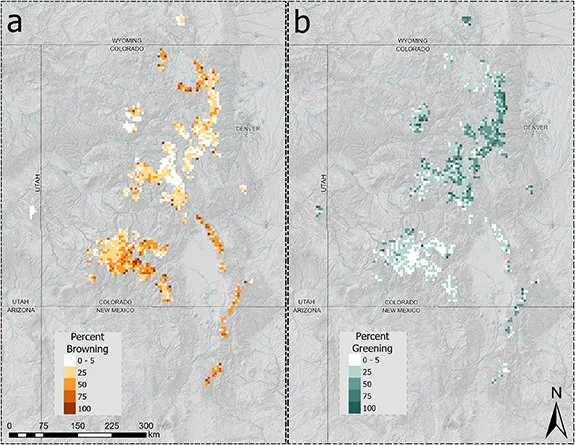
Regions of browning (left) and greening (right) across the Southern Rocky Mountain alpine zone. Figure credit: Moore 2026
Abstract
Despite widespread reports of tundra ‘greening’, it remains unclear whether greening is occurring in mid-latitude alpine tundra of the Southwestern United States, where vegetation productivity strongly influences headwater ecohydrology and ecosystem function. Using 39 years of Landsat data (1984–2023), experimental manipulations, and field measurements at the Niwot Ridge Long-Term Ecological Research site in Colorado, USA, we investigated how climate change is reshaping alpine greenness across the Southern Rocky Mountain alpine zone. Contrary to widespread greening trends documented in Arctic and European alpine tundra systems, normalized difference vegetation index (NDVI) declined 2.8% across this region, on average. Within the region, we found evidence of pronounced spatial heterogeneity in NDVI shifts, with 20.2% of the region browning while 17.6% greened. A four-year factorial snow and temperature manipulation experiment found that warming reduces NDVI while snow addition has a slight positive effect on NDVI, suggesting that soil moisture limitation can constrain productivity gains under warming in this semi-arid system. Regionally, summer warming increased the probability of either greening or browning, and the length of the snow-free season determined the direction of this relationship: browning was associated with lengthening growing seasons while greening occurred where growing seasons remained stable. These findings demonstrate that alpine productivity responses to climate change are not globally uniform and that regional context mediates temperature effects.